Maternity Dress Sizing Guide
Research-backed guidance on which measurement decides your size, and the three situations where the usual rule is wrong.
| # | Pick | Best for | Score | Price |
|---|---|---|---|---|
| 1 |  OUGES Wrap Pregnancy Maxi V Neck Maternity DressWrap tie waist — the most size-forgiving shape | Buying before you know what size you will be | 9.0/10 | |
| 2 |  OYOANGLE Maternity Mock Neck Sleeveless Ruched Bodycon Maxi DressSide ruching — stretches without changing size | A close fit you want to stay close | 8.6/10 | |
| 3 |  Kindred Bravely Essentials Ribbed Maternity Nursing DressRib knit with real recovery, true-to-size cut | Trusting the size on the label | 8.4/10 | |
| 4 | 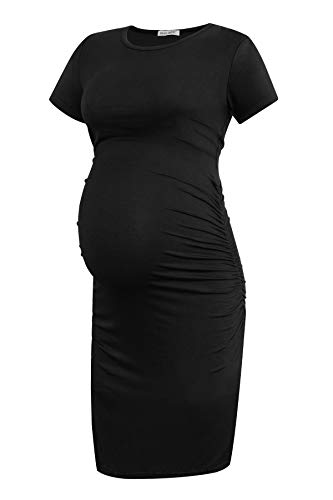 Smallshow Short Sleeve Maternity Dress RuchedSide ruching, knee length, jersey | Working out your size cheaply | 8.1/10 |
Rows link to the full write-up below. Scores are ours, from published specs and what buyers consistently report — we have not worn these.
By Selena H. · Last reviewed: October 2026
As an Amazon Associate, we earn from qualifying purchases. We do not set prices: the figure in each button is Amazon’s own, as of the date shown, and Amazon is authoritative when you click. How this site is funded.
The short answer
Order your pre-pregnancy size. Maternity dresses are cut from a pattern that already has the bump room in it, so a size up gives you a dress that is loose at the shoulder, the bust and the hip and no roomier where you needed it. Size up only in three specific cases: your bust has gone up more than one cup size, you were already between sizes before pregnancy, or the dress has a fitted band under the bust instead of smocking, ruching or a tie.
Why your normal size is the right answer
A maternity dress is not a bigger dress. It is a differently shaped one. The extra fabric is added in three specific places — over the abdomen, in the length at the front hem so it does not ride up as the bump grows, and in the rise if there is a waist seam. The shoulder width, the bust cup and the hip are drafted the same as they would be in the equivalent non-maternity size.
So when you order a size up, you get sleeves that slip, a neckline that gapes and a hem that hangs wrong, and the bump area is barely different because that part was never sized from the body measurement in the first place. The mistake is extremely common, which is why almost every maternity label now says "order your usual size" somewhere in the listing that nobody reads.
The three times you should size up
1. Your bust has gone up more than one cup size
Breast growth in pregnancy is substantial and it starts early, often in the first trimester. A maternity dress adds nothing at the bust, so if your chest measurement has moved by more than about two inches, the dress will be tight across the top long before it is tight anywhere else. A size up is the fix, or better, a shape with a smocked or wrapped bodice that stretches there. Our maternity bra guide covers the measurement side of this, and it is worth doing before you order a dress rather than after.
2. You were already between sizes
If you normally hover between a medium and a large, take the large. Hip and rib measurements do change in pregnancy for many people, and the failure mode of a too-small maternity dress is that it becomes unwearable, while the failure mode of a slightly too-large one is that it looks a bit loose.
3. The dress has a fitted band under the bust
Empire-line dresses with a non-stretch band are the one construction where the measurement has to be right on the day. A band cannot be let out and it sits exactly where your rib cage is expanding. If the dress is built this way and you are buying for an event weeks away, size up or buy a different shape.
Which measurement to take, and when
Take your bust at the fullest point, your natural waist where you would have one, and your hips at the widest. Do not measure around the bump — no maternity size chart uses it, because the bump measurement at the time of ordering tells you nothing about the bump measurement on the day you wear the dress. If a listing does ask for a bump measurement, treat the chart with suspicion.
Measure in the morning. Swelling across the day is normal and real, particularly in the third trimester, and an evening measurement will push you a size up for no good reason.
Shape matters more than size
For anything bought more than two weeks ahead, the shape of the dress decides whether the size will still be right. In descending order of forgiveness:
- Wrap with a tie — adjustable across the widest range. The safest thing to order early, which is why it dominates our wedding guest picks.
- Smocked bodice — stretches at the chest without a seam, so it absorbs bust growth as well as bump growth.
- Side ruching — grows with the bump while keeping a close fit. The standard mechanism on baby shower dresses.
- A-line and empire with stretch — forgiving at the hip, less so at the bust.
- Fitted bodycon or a dress with a back zip — the least forgiving. Buy these close to the date.
Length changes as the bump grows
This is the part people are surprised by. As the bump grows forward, the front hem of a dress rises — the fabric has to travel over the bump, and it comes from the hem. Well-drafted maternity dresses add length at the front to compensate; non-maternity dresses do not, which is why a normal dress that fit at 20 weeks is suddenly short at the front at 32. If you are tall, add this to the list of reasons to buy maternity rather than size up in regular clothes.
Non-maternity dresses that work anyway
Plenty do, and it is worth knowing which before you spend. Empire-line, A-line, smocked, wrap and anything that ties above the bump will often carry you a long way, particularly in the first and second trimesters. What fails is a fitted natural waist, a back zip, and non-stretch woven fabric. Our guide on when to start wearing maternity clothes covers the handover point, and for the bottom half, the maternity jeans sizing guide answers the same question for trousers, where the rules are slightly different.
After the birth
A maternity dress does not become a postpartum dress, because the shape it was built around is no longer there. What does carry over is anything with a nursing opening and anything with a tie. If you are buying one dress to span both, buy for nursing access and accept it will be loose over the abdomen for a while. Our postpartum comfortable clothes page covers what actually works in the first six weeks.
Every pick, in detail
Scores below are ours. They come from the published specification sheets and from the patterns in what buyers consistently report — not from wearing these ourselves.
Top pick · Buying before you know what size you will be
9.0/10OUGES Wrap Pregnancy Maxi V Neck Maternity Dress
If you have to order weeks ahead of the date you need it, buy a shape with a tie rather than a seam. A wrap with a tie waist is adjustable across a range no fixed bodice can match, which turns a sizing problem into a non-problem.
- Length
- Maxi
- Neck
- Wrap V-neck
- Shape
- Wrap front, tie waist
- Use
- Baby shower, events, work
What works
- Tie waist absorbs several weeks of bump growth
- Wrap front means no zip to fail at the back
- Works at 24 weeks and at 38 weeks in the same size
What it gives up
- Wrap fronts gape at the bust on a fuller chest
- Needs re-tying through a long day
- Floor length is cut for a heel on most people
Skip it ifyou want a dress whose fit is fixed and predictable.
#ad · affiliate link · price as of November 28, 2026
Pick 2 · A close fit you want to stay close
8.6/10OYOANGLE Maternity Mock Neck Sleeveless Ruched Bodycon Maxi Dress
Side ruching is the other mechanism that lets one size cover a range: the seam gathers the fabric and releases it as the bump grows. It keeps a close silhouette where a tie waist gives a loose one, so it is the better choice if you want the bump to be the shape of the dress.
- Length
- Maxi
- Fit
- Bodycon, ruched side seam
- Sleeve
- Sleeveless
- Use
- Bump-showing events and photos
What works
- Ruched seam lets a close fit grow without a size change
- Mock neck and maxi length keep it smart
- Holds its shape in photographs instead of gathering oddly
What it gives up
- Close fit is less comfortable over many hours
- Shows underwear lines without seamless pieces beneath
- Unforgiving after a large meal
Skip it ifyou would rather the dress skim than cling.
#ad · affiliate link · price as of November 28, 2026
Pick 3 · Trusting the size on the label
8.4/10Kindred Bravely Essentials Ribbed Maternity Nursing Dress
The practical case for a dedicated maternity label is that the sizing is consistent and the fabric recovers, so the dress is the same size in March as it was in January. If you have been burned by marketplace sizing that varies between colors of the same dress, this is the fix.
- Fabric
- Rib knit
- Access
- Nursing-friendly opening
- Span
- Maternity through breastfeeding
- Use
- Everyday, dressed up or down
What works
- Sizing is consistent across the label, so repeat orders fit
- Rib knit recovers instead of stretching a size over a month
- Nursing access extends the useful life well past the birth
What it gives up
- Costs more than the marketplace equivalents
- Plain, with no occasion styling
- Rib knit needs smooth underwear
Skip it ifyou need something formal for a specific event.
#ad · affiliate link · price as of November 28, 2026
Pick 4 · Working out your size cheaply
8.1/10Smallshow Short Sleeve Maternity Dress Ruched
If you are not sure what size you are in maternity wear yet, this is the cheapest way to find out with a dress you will keep wearing either way. Side-ruched jersey at knee length is forgiving of a sizing mistake in both directions, which is exactly what a first purchase should be.
- Detail
- Side ruching that grows with the bump
- Sleeve
- Short
- Use
- Work and events
- Fabric
- Stretch jersey
What works
- Cheap enough to treat as a sizing test
- Ruched jersey is forgiving if you guess a size wrong
- Neutral enough to wear to work afterwards
What it gives up
- Jersey shows underwear lines clearly
- Plain and unremarkable by design
- Knee length is less flattering late in pregnancy than a maxi
Skip it ifyou already know your maternity size and want the real dress.
#ad · affiliate link · price as of November 28, 2026
Questions people actually ask
Do maternity dresses run true to size?
Generally yes, from the dedicated maternity labels. The bump room is added to the pattern rather than taken from the size, so your pre-pregnancy size is the one to order.
Marketplace brands are less consistent, and sizing can vary between colors of the same dress. If a listing has a brand-specific size chart, use the chart rather than the letter size.
Should I size up in a maternity dress?
Only in three cases: your bust has grown more than one cup size, you were already between sizes before pregnancy, or the dress has a fitted non-stretch band under the bust.
Otherwise sizing up gives you a dress that is loose at the shoulders, bust and hip and no better over the bump, because that area was not sized from your body measurement.
What measurements do I need for maternity dress sizing?
Bust at the fullest point, natural waist, and hips at the widest. Measure in the morning, because swelling across the day is normal and an evening measurement can push you a size up for no reason.
Do not measure around the bump. No maternity size chart uses it, and the measurement on the day you order tells you nothing about the day you wear the dress.
What size maternity dress should I buy for an event in two months?
Your normal size, in an adjustable shape — a wrap with a tie, a smocked bodice, or side ruching. The shape matters far more than the size when you are buying ahead.
Avoid a fitted bodice or a back zip for anything more than two or three weeks out. Those are the constructions that cannot absorb a change in measurement.
Why do maternity dresses get shorter at the front?
Because the fabric that travels over the bump comes from the hem. As the bump grows forward, the front hem rises.
Maternity patterns add extra length at the front to compensate, which is one of the main differences between a maternity dress and a larger regular dress. A regular dress that fit at 20 weeks is often visibly short at the front by 32.
Will a maternity dress fit after the birth?
Loosely, and not well. The pattern was drafted around a bump, so the extra fabric sits in a place that no longer needs it.
The exceptions are dresses with a tie waist, which can be pulled in, and dresses with nursing access, which have a reason to be worn regardless of fit. Those are the ones worth buying if you want the dress to span both sides of the birth.
Sources
- MedlinePlus, US National Library of Medicine. Common symptoms during pregnancy
- American College of Obstetricians and Gynecologists. Skin Conditions During Pregnancy
- NHS. Swollen ankles, feet and fingers in pregnancy
Who wrote this
Selena H.
Selena owns Bump & Bolster and researches and writes every page herself. She built the site around the problems pregnancy throws at you in the order they arrive: sleep first, then pain, then nothing fitting, then recovery.